
- This event has passed.
2026 Park Science Colloquium
2026 Park Science Colloquium
This annual symposium on March 5, 2026 showcased the research happening in and around the Great Smoky Mountains. Topics are wide-ranging, from weather and climate to zoology, botany, geology, conservation, and more!
Stay tuned for details for the 2027 Park Science Colloquium!
Schedule
Check out talks from previous years
Information for presenters
Conference format: The format for this year’s Colloquium will be a little different than in recent years. We’re attempting to make this a hybrid event so folks can tune in remotely through Zoom or attend the event at Arrowmont. Our whole audience–in person or remote–will be able to see and hear presentations in the room at Arrowmont as well as talks given remotely via Zoom. As usual, the entire audience will be able to ask questions after each presentation (time permitting) and we will help field those questions. This, at least, is the smooth and seamless format we’re aiming for… We’ll try to work out the kinks ahead of time!
In-person presenters: We ask that folks presenting live at Arrowmont either email your presentation slides to Will (will@dlia.org) ahead of time or bring it on a flash drive to copy over to our on-site laptop. You’ll have the standard setup: a podium with microphone with projected slides.
Remote presenters: Speakers presenting remotely will can simply tune in using the custom Zoom link you’ll receive before the event and share your screen as you present (as in recent years of the colloquium).
Speakers do not need to register for the event, but will instead automatically be registered via the Zoom Webinar platform. Every presenter (remote or in-person) will get an email with a Zoom link, which in-person folks can disregard. If something comes up and you need to attend remotely instead of in-person, please notify Will and proceed to use your Zoom link to tune in. Note: the Webinar platform refers to presenters as “panelists” and the Zoom email you receive will refer to you as a panelist.
Time slots: Presentation slots will be around 20 minutes (including time for questions). We will send you a finalized schedule close to the event with your exact timeslot.
Presentation format: Remote presenters can have slide decks in any format (speakers will share their screen via Zoom), however we recommend PowerPoint, PDF, Google Slides or Keynote in wide-format (16:9). PDF is preferred for in-person presenters, though PowerPoint or Google Slides will also work.
Know your audience: Please note that many in the audience will have advanced degrees, but few will have advanced degrees in your topic, so plan to provide a bit of explanation of technical jargon and stay away from acronyms.
Recording presentations: We plan to record presentations and upload them publicly to our YouTube channel as we’ve done in recent years. Please let Will know if you DO NOT wish for your presentation to be published to YouTube.
Welcome NEON!
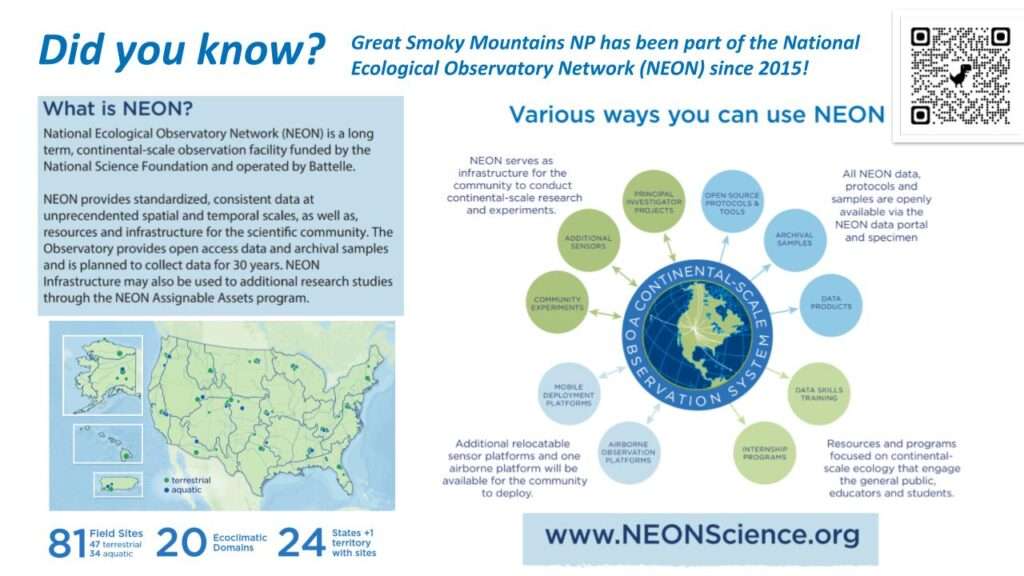
Representatives from the NSF-funded National Ecological Observatory Network (NEON) will be on site to talk about the treasure trove of continental-scale, open data available from sites across the US, including Great Smoky Mountains National Park. Learn more at https://www.neonscience.org/